
The 2027 payment notice for the Affordable Care Act (ACA) marketplaces, the yearly HHS rule on their standards and fees, took effect on July 20, 2026. Several of the rules it set out to replace still govern 2027 coverage. On July 16, a federal judge in Maryland stayed 8 of the final rule’s provisions, among them the repeal of standardized plan options and the end of the requirement that Exchanges accept an applicant’s income attestation when the IRS has no tax data.
The order came in City of Columbus v. Kennedy, a suit by the cities of Columbus, Baltimore and Chicago, Pima County in Arizona, Doctors for America and Main Street Alliance. Judge Brendan Hurson found the plaintiffs likely to succeed against all 8 provisions. The Centers for Medicare & Medicaid Services (CMS) has since listed them among the provisions that did not or will not go into effect.
The rule also needed repairs of its own. A correction published July 21 and effective July 20 fixed a preamble sentence that misstated the effective date, along with 2 amendatory instructions. As printed, the instruction for 45 CFR § 155.170, the regulation on state-mandated benefits, would have deleted text that CMS never proposed to rescind.
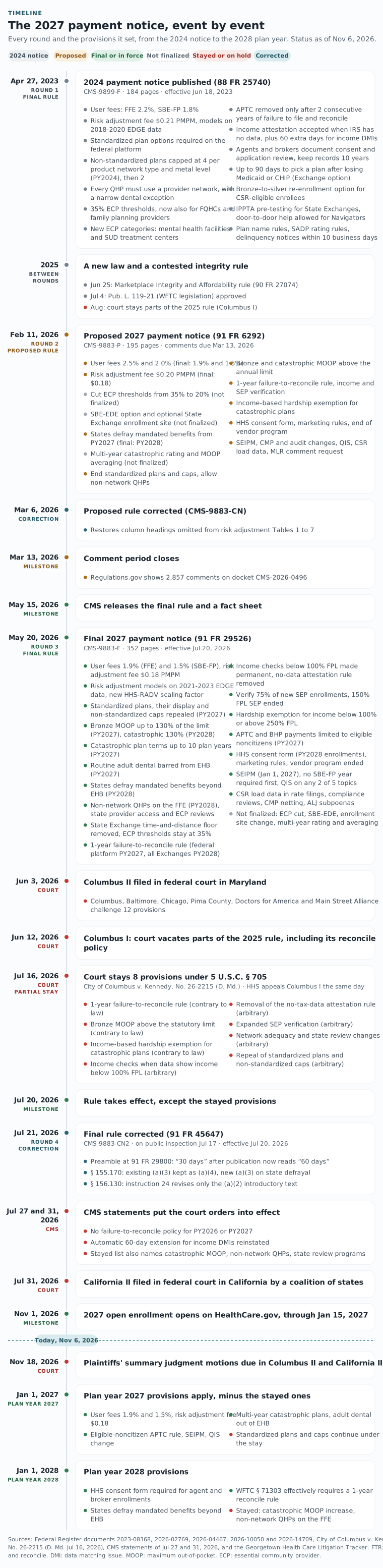
The record runs in 4 rounds, each a Federal Register document.
- April 27, 2023. The 2024 payment notice sets many of the rules the 2027 notice later targets.
- February 11, 2026. CMS proposes the 2027 notice, with comments due March 13.
- May 20, 2026. The final 2027 notice is published, keeping most of the proposal.
- July 21, 2026. A correction fixes 3 drafting errors in the final rule.
Key takeaways
- 8 provisions are stayed. The July 16 order covers the 1-year failure-to-reconcile policy, 2 income verification changes, wider verification of special enrollment periods (SEPs), the bronze out-of-pocket increase, an income-based hardship exemption for catastrophic plans, the network adequacy changes and the repeal of standardized plans.
- Older rules fill the gap for 2027. Issuers on the federal platform must keep offering standardized plans, with limits on other designs. Exchanges must still accept income attestations when the IRS has no tax data. Under a July 27 CMS statement, Exchanges may not remove or deny advance payments of the premium tax credit (APTC) for failure to reconcile in 2026 or 2027.
- Some proposals did not survive. CMS dropped its plan to cut essential community provider (ECP) thresholds from 35% to 20%. It also set user fees of 1.9% and 1.5% instead of the proposed 2.5% and 2.0%.
- The correction made 3 fixes. A preamble line that misstated the effective date is fixed, and the July 20 date in the rule’s DATES section stands. The § 155.170 instruction now keeps existing text as paragraph (a)(4), and the § 156.130 instruction now changes only the introductory text of paragraph (a)(2).
- Much of the rule is in force. The lower user fees, a $0.18 risk adjustment fee, the limit on APTC to eligible noncitizens, multi-year catastrophic plans and new marketing rules for agents and brokers are all outside the stay.
The 2024 payment notice set the rules the 2027 notice targets
CMS published the HHS Notice of Benefit and Payment Parameters for 2024 on April 27, 2023 (88 FR 25740), effective June 18, 2023. Its rules on plan choice and enrollment checks are the ones the 2027 notice went after.
- Standardized plans and a cap on alternatives. Issuers on the federal platform had to keep offering standardized plan options. Non-standardized designs were capped at 4 per product network type and metal level in a service area for plan year 2024, then 2.
- A network for every plan. Every qualified health plan (QHP) had to use a provider network, with a narrow exception for some stand-alone dental plans.
- Higher ECP floors. Plans had to contract with at least 35% of available federally qualified health centers and 35% of available family planning providers, on top of the overall 35% threshold.
- 2 years before APTC ends. Exchanges could remove APTC only after a household failed to file and reconcile for 2 consecutive years.
- Income attestations accepted. When the IRS had no tax data for an applicant, Exchanges had to accept the applicant’s own statement of projected income. Enrollees with income data matching issues (DMIs) got an automatic 60-day extension to resolve them.
- Paper trails for agents and brokers. Agents and brokers had to document consumer consent and their review of application information, and keep the records for 10 years.
The same notice set 2024 user fees at 2.2% of premium on the federally facilitated Exchange (FFE) and 1.8% on State-based Exchanges on the Federal platform (SBE-FPs). The risk adjustment fee was $0.21 per member per month.
Two events in 2025 set up what came next. On June 25, 2025, CMS published the Marketplace Integrity and Affordability rule (90 FR 27074). Several of its income and enrollment checks were temporary, and the 2027 notice would make some of them permanent. The same Maryland court stayed parts of that rule in August 2025. On June 12, 2026, in the case now called Columbus I, it struck the reconcile policy in 45 CFR § 155.305(f)(4), including the 2025 amendments.
On July 4, 2025, Pub. L. 119-21 was approved. CMS calls it the Working Families Tax Cut (WFTC) legislation. Among other changes, it narrows which lawfully present immigrants can receive premium tax credits, starting in 2027, and from 2028 it effectively requires a 1-year reconcile policy. Its Medicaid integrity provisions are the subject of an earlier Rounds analysis.
The February proposal went further than the final rule
The proposed 2027 notice appeared on February 11, 2026 (91 FR 6292), with comments due March 13. A March 6 correction (CMS-9883-CN) restored column headings left out of 7 risk adjustment tables. The Federal Register page shows 2,857 comments received at Regulations.gov.
Most of the proposal survived. These pieces did not survive intact.
- ECP thresholds. CMS proposed cutting the 35% thresholds to 20%. The final rule keeps them at 35%.
- A new State Exchange model. CMS did not finalize an optional model in which a State Exchange would rely on approved web-brokers and issuers using enhanced direct enrollment (EDE). The CMS fact sheet says the agency plans to consider it again in the 2028 payment notice rulemaking or another one. A change to § 155.205(b) that would have made a State Exchange’s centralized enrollment site optional was also left out.
- Multi-year catastrophic plans. Terms of up to 10 plan years were finalized. The proposed multi-year rating adjustment and the option to average the out-of-pocket limit across the term were not.
- Fees. Proposed user fees of 2.5% and 2.0% became 1.9% and 1.5%. The proposed $0.20 risk adjustment fee became $0.18.
- State-mandated benefits. The proposal would have started the new defrayal rules in plan year 2027. The final rule starts them in plan year 2028. From then, under certain conditions, any state-required benefit is treated as in addition to the essential health benefits (EHB), and states must pay its cost for QHP enrollees.
The May final rule kept most of the proposal
CMS released the final rule on May 15 and published it on May 20, 2026 (91 FR 29526). It runs 352 pages and took effect July 20. The table tracks 10 provisions from the 2024 baseline through each round.
| Provision | 2024 notice (2023) | Proposed (Feb 2026) | Final (May 2026) | For 2027 coverage |
|---|---|---|---|---|
| Failure to file and reconcile | APTC ends after 2 straight years | 1-year policy | 1-year policy, federal platform first | No check, under the stay and the Columbus I order |
| No-data income attestation | Must be accepted | Requirement removed | Removed | Stayed. Still accepted |
| Standardized plan options | Required, other designs capped | Repealed | Repealed from plan year 2027 | Stayed. Still required |
| Provider networks | Required for every QHP | Non-network plans allowed | Allowed on the FFE from 2028 | Stayed |
| ECP thresholds | 35%, also for FQHCs and family planning | Cut to 20% | Not finalized | 35% applies |
| Bronze out-of-pocket maximum | Statutory limit | Above the limit | Up to 130% of the limit | Stayed |
| User fees (FFE, SBE-FP) | 2.2%, 1.8% | 2.5%, 2.0% | 1.9%, 1.5% | Apply |
| Risk adjustment fee | $0.21 | $0.20 | $0.18 | Applies |
| Agent and broker consent | Records kept 10 years | HHS form | HHS form from plan year 2028 | Not stayed, starts in 2028 |
| State Exchange payment checks | Pre-testing (IPPTA) | Measurement (SEIPM) | SEIPM from Jan 1, 2027 | Applies |
Sources are the Federal Register documents for each round and, for the last column, the July 16, 2026 stay as CMS applied it on July 27 and 31. The risk adjustment fee is per member per month, and user fees are a share of premium. IPPTA is the Improper Payment Pre-Testing and Assessment program, and SEIPM is State Exchange Improper Payment Measurement.
Several finalized provisions change what enrollees pay or what plans cover. For plan year 2027, the out-of-pocket limits are $12,000 for self-only coverage and $24,000 for a family, as the court’s opinion notes, citing the rule. The bronze provision would have let an issuer that also sells a compliant bronze plan offer bronze plans with limits up to $15,600 and $31,200. Catastrophic plans were set to move to the same 130% ceiling in 2028. Both changes are stayed. Outside the stay, the rule bars issuers from including routine adult dental services as an EHB from plan year 2027 and limits APTC to eligible noncitizens.
CMS’s own analysis projected coverage losses. The court cited the rule’s estimate that 1.2 million to 2 million people would drop coverage (91 FR 29854).
The July correction fixed 3 drafting errors
The correction (CMS-9883-CN2) went on public inspection on July 17 and was published on July 21, 2026 (91 FR 45647). It is effective July 20, the same date as the rule. It is the second correction in this rulemaking. The first, in March, fixed the proposed rule.
| Location in the final rule | Provision | As published | As corrected | Effect, as CMS describes it |
|---|---|---|---|---|
| 91 FR 29800, column 3, last paragraph, line 8 | Preamble statement of the effective date | “effective 30 days after publication” | “effective 60 days after publication” | The final rule is a major rule that generally must have a 60-day delayed effective date under the Congressional Review Act |
| 91 FR 29864, column 3, amendatory instruction 9 and regulation text | 45 CFR § 155.170(a) | Instruction would have removed existing paragraph (a)(3) | Revises (a)(1) and (a)(2), redesignates (a)(3) as (a)(4) and adds a new (a)(3) | CMS did not propose to rescind (a)(3) and did not intend to finalize its rescission |
| 91 FR 29874, column 1, amendatory instruction 24 | 45 CFR § 156.130(a)(2) | “revising paragraph (a)(2)” | “revising paragraph (a)(2) introductory text” | A clarification with no effect on the content or meaning of the regulation |
The source is 91 FR 45647, sections II through IV. The preamble fix changes no CFR text. The other 2 correct amendatory instructions for regulation text.
The § 155.170 fix matters most. As corrected, the new (a)(3) says a state “must make payments in accordance with paragraph (b) of this section to defray the cost of any State-required benefits in addition to the EHB.” The text it preserved, now § 155.170(a)(4), is the provision under which a state identifies which of its required benefits are in addition to EHB. CMS said it “did not propose to rescind § 155.170(a)(3)” and found good cause to make the fix without notice and comment, because a delay would be contrary to the public interest.
The § 156.130 fix is technical, but it touches a provision on hold. The introductory text it confines the change to now opens “Except as permitted in § 156.136 and § 156.155(a)(3)(ii),” the bronze and catastrophic exceptions. CMS’s July 31 statement lists § 156.130(a)(2) among the provisions that did not or will not take effect.
The July 16 stay decides what applies in 2027
The plaintiffs in Columbus II sued on June 3, 2026, challenging 12 provisions, and asked the court to stay 8 of them under 5 U.S.C. § 705. In a July 16 opinion, the court stayed all 8 before the rule’s effective date. Georgetown Law’s health care litigation tracker follows the docket.
The court found 3 provisions likely contrary to law.
- The 1-year reconcile policy. APTC eligibility follows a formula set in statute. “CMS is not free to re-write the statutory formula to accomplish its policy goals,” the court wrote.
- The bronze out-of-pocket increase. The statute’s annual limit on cost sharing applies to bronze plans like any other, and the court found no room for a bronze exception.
- The income-based hardship exemption. The court read “hardship” as more than income alone, since the statute has a separate exemption for coverage that is unaffordable.
It found the other 5 likely arbitrary and capricious.
- Income checks below 100% of the federal poverty level (FPL). The new data did not tie the check to the broker fraud it targeted. “The agency’s chosen solution remains unmoored from the problem,” the court wrote.
- Removal of the no-data attestation rule. CMS offered no evidence linking self-attestation to the broker fraud it cited, so “the solution adopted remains incongruent to the problem identified.”
- Wider SEP verification. CMS inferred fraud from a shift in SEP use without engaging the obvious alternative explanation commenters raised. “Defendants cannot merely state a belief to avoid engaging with data,” the court wrote. It also faulted CMS for making the checks permanent after earlier treating them as temporary, without explaining the change.
- Network adequacy changes. CMS did not answer comments warning that states could relax time-and-distance standards.
- Repeal of standardized plans. CMS gave no reasoned basis for reversing course, and it conceded that nearly 8 million people had enrolled in standardized plans the year before.
The stay did not freeze the 2027 payment notice. For 2027 coverage, it kept the 2024 notice’s choices on plan design and income checks in place.
CMS issued implementing statements on July 27 and July 31. The July 27 statement told Exchanges to stop removing or denying APTC over failure to reconcile in plan year 2026 and to continue that approach for 2027. It says the June 12 order in Columbus I struck the reconcile policy in § 155.305(f)(4) and that earlier guidance on the 2-year policy “is no longer valid.” HHS also reinstated the automatic 60-day extension for income DMIs. The July 31 statement goes beyond the 8 stayed provisions, listing the catastrophic out-of-pocket increase, non-network plans on the FFE and the state review programs for provider access and ECPs.
A second suit followed. A coalition of states filed California v. Kennedy in the Northern District of California on July 31, 2026. Plaintiffs’ summary judgment motions are due November 18, 2026, in both cases, according to the Georgetown tracker. HHS appealed the Columbus I ruling on July 16. Because the Columbus II stay is preliminary, the stayed provisions could still take effect if HHS prevails.
What applies to ACA marketplace coverage in 2027 and 2028
Open enrollment on HealthCare.gov runs from November 1, 2026 to January 15, 2027, according to the July 27 statement. KFF notes that no one will be disqualified from 2027 tax credits for failing to file and reconcile.
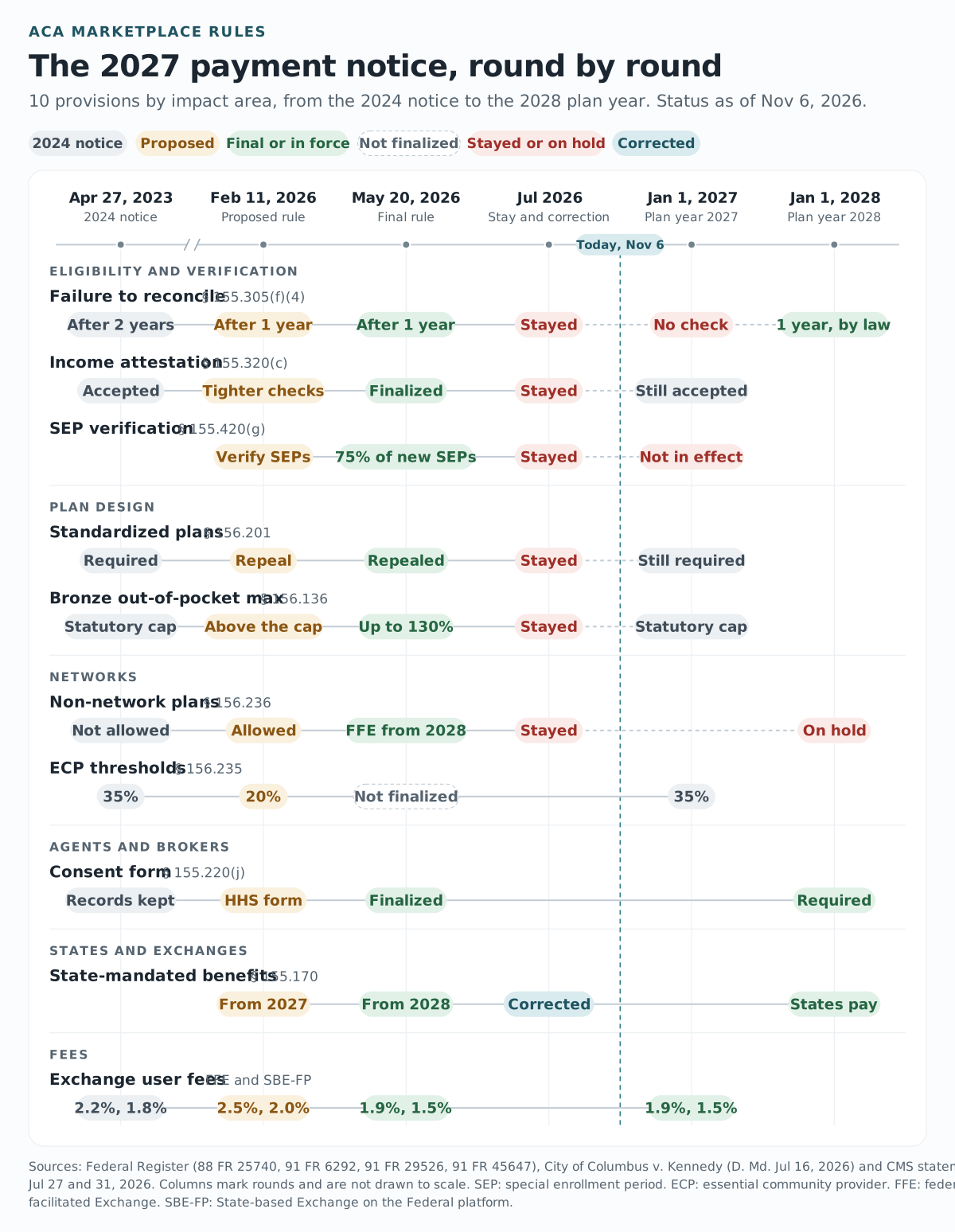
Outside the stay, the final rule governs plan year 2027.
- Fees. User fees of 1.9% on the FFE and 1.5% on SBE-FPs, and a $0.18 risk adjustment fee.
- Eligibility. APTC and federal Basic Health Program payments only for citizens and eligible noncitizens, and the end of the 150% FPL special enrollment period.
- Plans. Catastrophic plans with terms of up to 10 plan years, and routine adult dental services outside EHB.
- Oversight. New marketing rules for agents and brokers, and State Exchange Improper Payment Measurement from January 1, 2027. Issuers also reported cost-sharing reduction (CSR) load data in their 2027 rate filings.
Plan year 2028 brings the HHS consent form for agent and broker enrollments and state payment for mandated benefits in addition to EHB. It is also when section 71303 of the WFTC legislation effectively requires a 1-year reconcile policy. The court acknowledged the shift, writing that in plan year 2028 “many of Plaintiffs’ arguments in this and the related case will be neutralized.”
About this analysis
Basis. The 2024 payment notice, the 2027 proposed rule and the 2027 final rule are described from their Federal Register versions, and dates come from each document’s DATES section. The March and July 2026 corrections are described from their Federal Register and govinfo versions. The stay is described from the court’s July 16, 2026 memorandum opinion, read from a copy posted by the American Hospital Association. What CMS is enforcing comes from its statements of July 27 and July 31, 2026. Provisions of the final rule are checked against the CMS fact sheet of May 15, 2026.
Definitions. “Stayed” means the court postponed a provision’s effective date under 5 U.S.C. § 705 while the case proceeds. It is not a final judgment. Each “round” is one of the 4 Federal Register documents listed at the top, not a legal term.
Data notes. The 2,857 comment count is the Regulations.gov figure shown on the proposed rule’s Federal Register page on November 6, 2026, and it can change. The coverage estimate of 1.2 million to 2 million people, the 2027 out-of-pocket limits and the bronze ceilings are the rule’s figures as the court’s opinion states them. Litigation status is current to November 6, 2026.
Frequently asked questions
What did the July 2026 correction to the 2027 payment notice change?
It fixed a preamble line that misstated the effective date and corrected 2 amendatory instructions. The § 155.170 instruction now keeps existing text as paragraph (a)(4), and the § 156.130 instruction changes only the introductory text of paragraph (a)(2).
Which 2027 payment notice provisions are stayed?
The 1-year failure-to-reconcile policy, 2 income verification changes, wider SEP verification, the bronze out-of-pocket increase, the income-based hardship exemption, the network adequacy changes and the repeal of standardized plans. CMS’s July 31 statement also lists the catastrophic out-of-pocket increase and non-network plans on the FFE among provisions that will not take effect.
Are standardized plans still required for 2027?
Yes. Because the repeal is stayed, issuers on the federal platform must still offer standardized plan options in 2027, with limits on non-standardized designs.
When did the 2027 ACA payment notice take effect?
The final rule took effect on July 20, 2026, apart from the provisions stayed on July 16. The July 21 correction is also effective July 20, 2026.